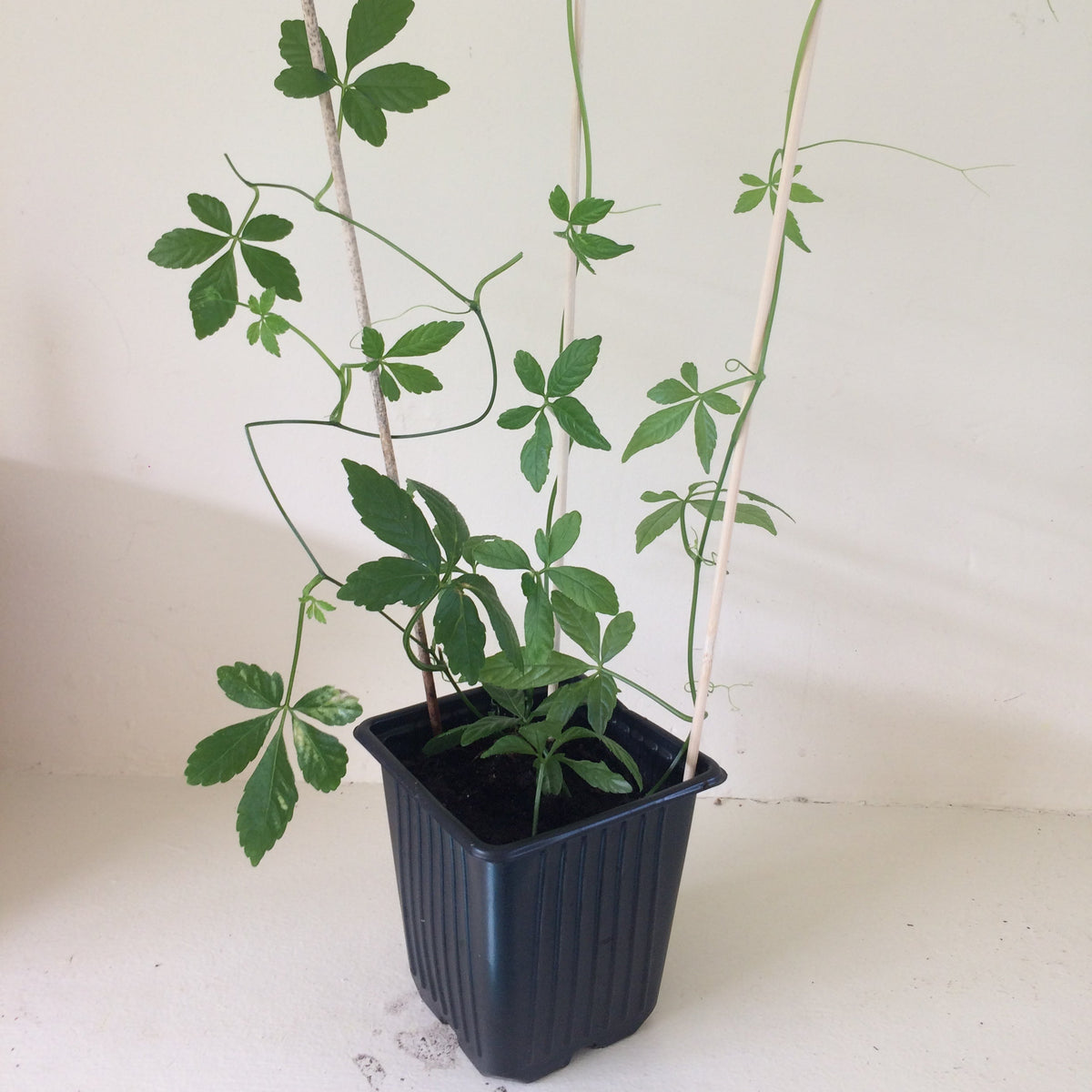
Jiaogulan (Gynostemma pentaphyllum) Plant
Jiaogulan (Gynostemma pentaphyllum) Plant
In stock
Couldn't load pickup availability
Gynostemma pentaphyllum, also called Jiaogulan, is a dioecious, herbaceous climbing or creeping vine belonging to Cucurbitaceae family. Native to Asia it grows in mountain forests, valleys, stream banks, roadsides, bushes, shaded and humid places at an elevation of 300–3200 m.
Jiaogulan grows slender stems with deep green leaves arranged like fingers on a hand, The leaflets are long and pliable, rough and crisp to the touch on both sides, a deep green on the upper side and a light green underneath. G. pentaphyllum has male and female pale green or white flowers on separate plants The female flowers are much smaller than the male. The fruit is a smooth, globular, small berry about 5–6 mm in diameter and black when ripe. The flowering season in the northern hemisphere is March to November; the fruiting season - December to April.
Jiaogulan use as medicine, dietary supplement and food dates back 500 years and is extremely versatile and valued in many traditional medicine systems. G. pentaphyllum leaves can be harvested when the vine reaches 2–3 m in length several times per season.
Plant Details
Botanical Name: Gynostemma pentaphyllum
Common Name: Jiaogulan
Pot Size: Supplied in 7 or 9 cm
Plant Type: Hardy perennial
Height at maturity: Can be controlled to desired height, can grow up to 9m
Position: Thrives in warm and humid environment. Shaded, damp and sheltered areas, under the trees
Soil: A soil pH in the range 5.5–8.0, with an optimal pH of 6.5–7.0 more than
30 cm deep, rich in humus, nitrogen, phosphorus and moisture. Well aerated fertile sandy loam.
Flowering: March to November
Wildlife Friendly: non toxic to wildlife
Origin: Grown in organic compost from cuttings in Ireland.
Growing Guide
Plant Jiaogulan in spring, summer or autumn in well-drained soil in shaded areas. Give it plenty of space and vertical support for its full potential. Wind damage is common for this plant and can be reduced by introducing wooden sticks so that the plant can intertwine itself. Water regularly if the season is dry. An ideal fertiliser is a nitrogen–phosphate–potassium compound applied 2–3 times during the active growth period if needed. It can be susceptible to slugs and snails, but usually overcomes them once the growth accelerates in spring.
Share